Rapid Prototyping Guide: Methods, Materials, and Process Selection
A breakdown of FDM, SLA, SLS, MJF, and CNC machining for prototype development: when to use each, how to match process and material to your validation goal.
Read the ArticleAerospace-grade PEI with high strength-to-weight and flame retardancy.
ULTEM 9085 is a high-performance PEI thermoplastic offering an excellent strength-to-weight ratio, high heat resistance, and inherent flame, smoke, and toxicity (FST) performance. It is widely specified for aerospace, rail, and demanding industrial end-use parts.
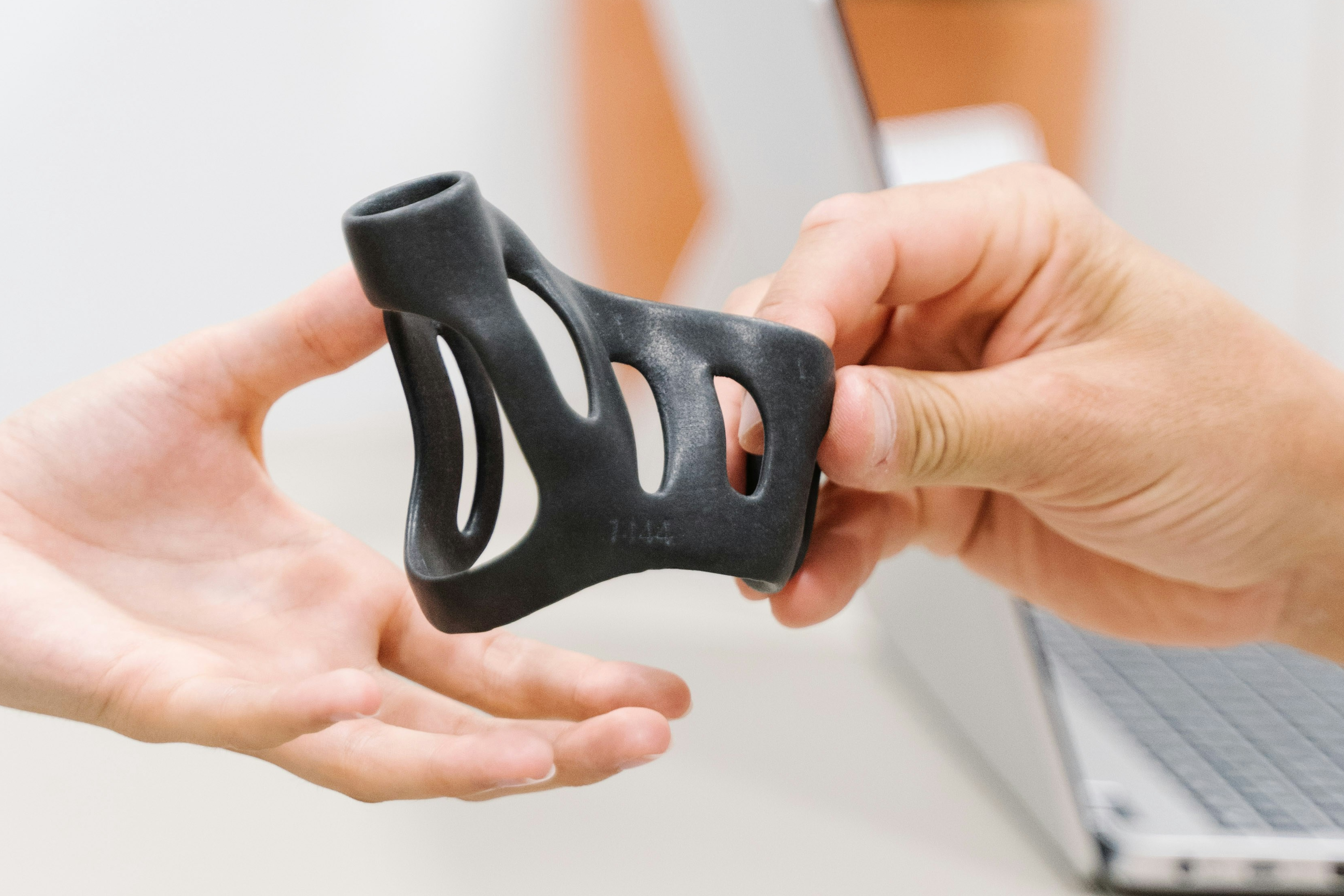
Polyetherimide (PEI) 9085, printed with Fused Deposition Modeling (FDM). Every order is reviewed by our engineering team - no minimum order quantity.
Choose ULTEM 9085 when your part must meet aerospace or transit flame-smoke-toxicity (FST) requirements, typically FAR 25.853, EN 45545, or equivalent specifications. ULTEM 9085 is one of the few 3D-printable materials that is widely accepted for certified flight hardware and rail interiors. No other material in our catalog matches its combination of FST performance, strength-to-weight, and 153 °C heat deflection.
If your primary need is flame retardancy without aerospace FST certification, PC-FR offers lower cost and shorter lead time, with UL 94 V-0 rating and 113 °C HDT. PC-FR handles most industrial electrical and enclosure applications.
If your application exceeds 153 °C or requires chemical resistance and sterilizability, ULTEM 1010 is the step up - it reaches 216 °C HDT and withstands autoclaving and harsh chemicals. The trade-off between 9085 and 1010 is: 9085 for FST/aerospace, 1010 for temperature and chemical extremes.
Representative values - process- and orientation-dependent. Full technical datasheet available on request.
Plan features to print reliably and assemble cleanly in ULTEM 9085. Need DFM help?
Typical tolerance is ±0.25 mm or ±0.2% on industrial FDM platforms - tighter than desktop FDM. ULTEM 9085 has controlled, predictable shrinkage that industrial machines compensate for automatically. Anisotropy between XY and Z directions is present - Z-axis tensile strength is roughly 40–60% of XY. Orient critical load paths along XY axes. Post-machining is available for critical features.
ULTEM 9085 requires industrial FDM equipment (Stratasys Fortus-class or equivalent) with chamber temperatures of 180–200 °C and nozzle temperatures of 350–400 °C. This is not printable on desktop machines. Build times are longer due to the high-temperature process and required soak/cool-down cycles. ULTEM is highly hygroscopic and requires aggressive drying (150 °C, 4+ hours in industrial dryers). Support material is ULTEM-specific (breakaway or soluble depending on geometry) and support removal can leave witness marks.
ULTEM 9085 alongside related materials.
| ULTEM 9085 | ULTEM 1010 | PC-FR | PA12 (SLS) | |
|---|---|---|---|---|
| Tensile strength | 42–69 MPa | 48–81 MPa | 60 ± 4 MPa | 48 MPa |
| Heat deflection (HDT) | 153 °C @ 1.82 MPa | 216 °C @ 0.45 MPa | 113 °C @ 0.45 MPa | 154 °C @ 0.45 MPa |
| Flexural modulus | 2,050–2,300 MPa | 2,230–2,820 MPa | 1,890 ± 70 MPa | 1,730 MPa |
| Elongation | 5–6% | 3–6% | 5–8% | 15–20% |
| Density | 1.34 g/cm³ | 1.27 g/cm³ | 1.20 g/cm³ | 1.01 g/cm³ |
| Relative cost | $$$$ | $$$$ | $$ | $$$ |
Where ULTEM 9085 fits, where it doesn't, and what to use instead.
FST-rated to FAR 25.853 with 42–69 MPa tensile at only 1.34 g/cm³ - one of the few printable materials accepted for certified flight hardware in cabin and cockpit interiors.
AerospaceMeets EN 45545 smoke and toxicity requirements for passenger-car interior components, eliminating the need for secondary fire-barrier coatings.
Aerospace153 °C HDT survives autoclave lay-up environments and composite-cure ovens that destroy nylon or ABS tooling within a single cycle.
EngineeringHandles sustained engine-bay temperatures of 130–150 °C for air ducting, sensor housings, and wire-routing brackets in motorsport and OEM development.
AutomotiveSaves 50–70% weight versus aluminum for comparable-strength brackets, with no CNC tooling cost - viable for 1–200 unit aerospace production.
AerospaceFinishing options and in-stock colors for ULTEM 9085.
As-printed industrial finish; support removal.
Best for: End-use & aerospace parts
Custom colors and dyeing available on request. Contact us for options.
A breakdown of FDM, SLA, SLS, MJF, and CNC machining for prototype development: when to use each, how to match process and material to your validation goal.
Read the Article