Rapid Prototyping Guide: Methods, Materials, and Process Selection
A breakdown of FDM, SLA, SLS, MJF, and CNC machining for prototype development: when to use each, how to match process and material to your validation goal.
Read the ArticleFlame-retardant polycarbonate with high strength and heat resistance.
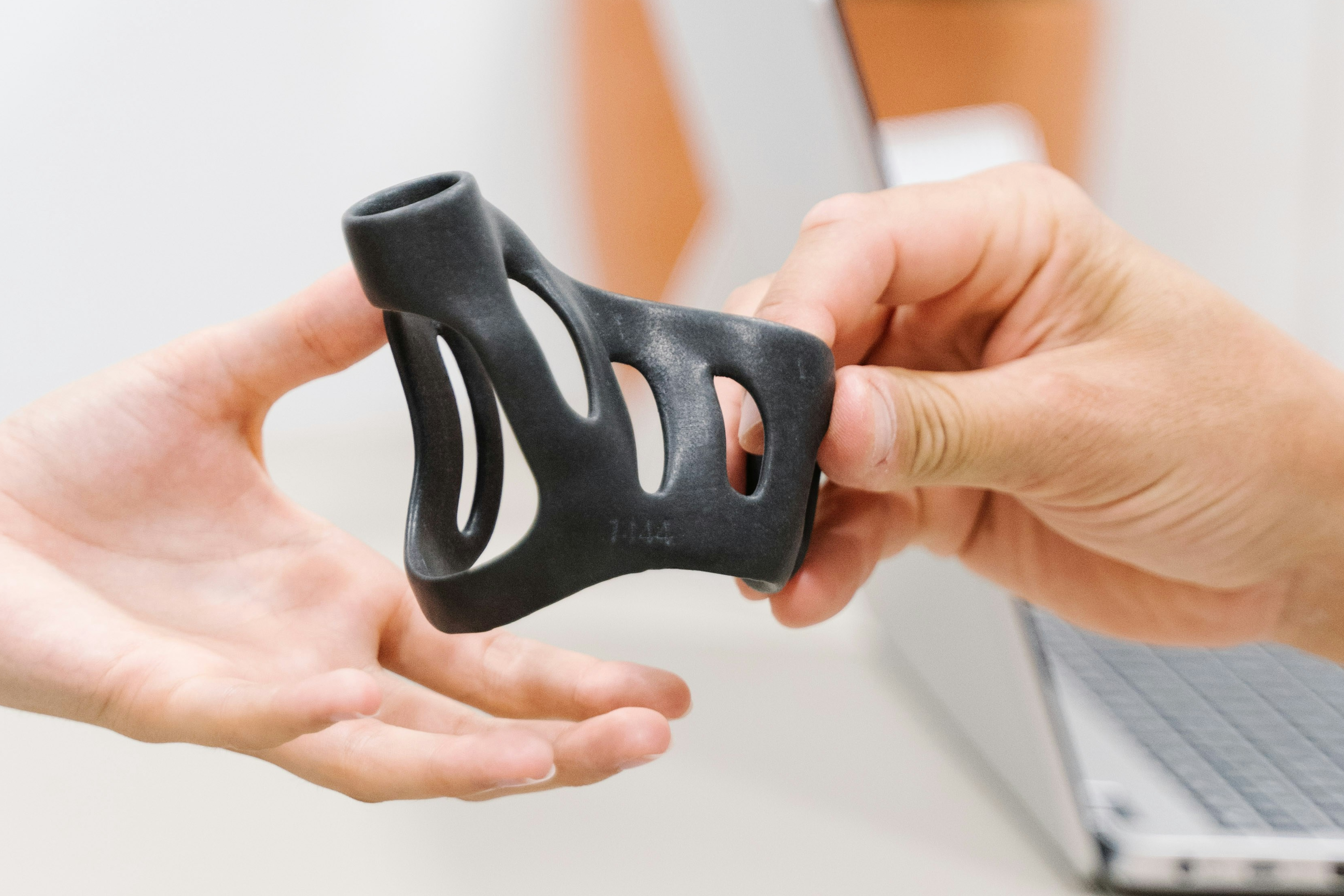
PC-FR is a flame-retardant polycarbonate engineered for high impact strength, thermal stability, and UL 94 V-0 rated fire resistance. It is built for industrial, electrical, and transit applications that demand mechanical durability together with flame retardancy.
Flame-Retardant Polycarbonate, printed with Fused Deposition Modeling (FDM). Every order is reviewed by our engineering team - no minimum order quantity.
Choose PC-FR when your part requires flame retardancy and real mechanical strength. Its UL 94 V-0 rating means it self-extinguishes quickly and does not drip flaming particles - a hard requirement for electrical enclosures, battery housings, transit interior parts, and any application governed by fire safety codes.
PC-FR is also one of the strongest FDM materials we print at 60 MPa tensile, significantly outperforming ABS (33 MPa) and ASA (37 MPa). If strength is the driver and flame retardancy is a bonus, PC-FR delivers. Its 113 °C HDT puts it well above ABS and ASA territory.
For higher temperature applications (above 130 °C), ULTEM 9085 and ULTEM 1010 are the next steps up, but at significantly higher cost and longer lead times. PC-FR is our most capable high-performance FDM material.
Representative values - process- and orientation-dependent. Full technical datasheet available on request.
Plan features to print reliably and assemble cleanly in PC-FR. Need DFM help?
Typical tolerance is ±0.35 mm or ±0.5%. PC-FR has moderate shrinkage and requires careful chamber temperature management to achieve consistent accuracy. Large parts (>150 mm in any axis) may see increased warp; uniform wall design and strategic orientation are critical. Post-machining is available for critical features - PC drills and taps cleanly.
PC-FR prints at 260–280 °C nozzle / 100–120 °C bed and requires a fully enclosed, actively heated chamber held at 60–70 °C ambient. This is one of the most demanding FDM materials to print reliably. PC-FR is extremely moisture-sensitive - we dry at 80 °C for 8+ hours and print from a dry-box to maintain filament quality throughout the job. Undried PC-FR produces weak, bubbly parts with delamination. Support removal requires care as the material is stiff; we orient to minimize supports on critical surfaces. Standard brass nozzles work, though hardened steel is preferred for long-run reliability.
PC-FR alongside related materials.
| PC-FR | ULTEM 9085 | ABS-GF | ABS | |
|---|---|---|---|---|
| Tensile strength | 60 ± 4 MPa | 42–69 MPa | 36 ± 3 MPa | 33 ± 3 MPa |
| Heat deflection (HDT) | 113 °C @ 0.45 MPa | 153 °C @ 1.82 MPa | 99 °C @ 0.45 MPa | 87 °C @ 0.45 MPa |
| Flexural modulus | 1,890 ± 70 MPa | 2,050–2,300 MPa | 2,860 ± 130 MPa | ≈ 2,200 MPa |
| Elongation | 5–8% | 5–6% | 3–5% | 10–15% |
| Density | 1.20 g/cm³ | 1.34 g/cm³ | 1.12 g/cm³ | 1.05 g/cm³ |
| Relative cost | $$ | $$$$ | $$ | $$ |
Where PC-FR fits, where it doesn't, and what to use instead.
UL 94 V-0 self-extinguishes in <10 seconds without dripping flaming particles - a hard requirement for NEC- and IEC-governed enclosures.
Energy60 MPa tensile at 1.20 g/cm³ delivers a strength-to-weight ratio competitive with aluminum sheet for non-primary structural interior panels.
AerospaceAt 60 MPa tensile - nearly 2x ABS - PC-FR carries real structural loads in motor mounts, conveyor bracketry, and control-cabinet internals.
Engineering113 °C HDT combined with flame retardancy meets the thermal-runaway safety margins required for lithium-ion battery pack enclosures and EV charger housings.
AutomotiveSatisfies UL 94 V-0 for transit authorities and marine certifiers that mandate flame-rated materials in passenger compartments.
AerospaceFinishing options and in-stock colors for PC-FR.
As-printed with support removal; matte surface.
Best for: Functional industrial parts
Custom colors and dyeing available on request. Contact us for options.
A breakdown of FDM, SLA, SLS, MJF, and CNC machining for prototype development: when to use each, how to match process and material to your validation goal.
Read the Article