Rapid Prototyping Guide: Methods, Materials, and Process Selection
A breakdown of FDM, SLA, SLS, MJF, and CNC machining for prototype development: when to use each, how to match process and material to your validation goal.
Read the ArticlePP-like resin balancing stiffness and flexibility for snap-fits and living hinges.
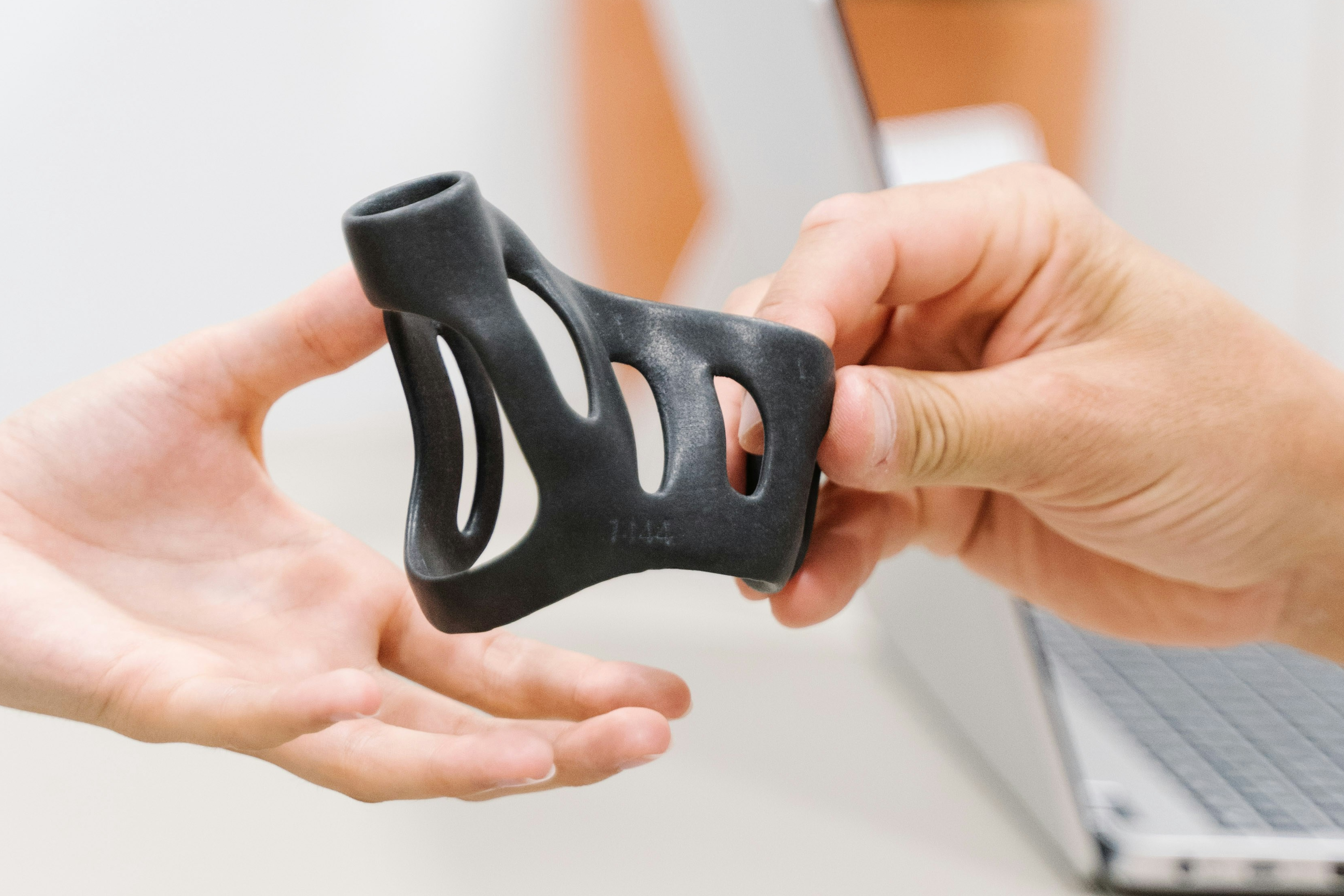
Tough 1500 sits between Tough 1000 and Tough 2000 on the stiffness spectrum, delivering PP-like behavior - enough rigidity to hold shape under gravity while still flexing at snap-tabs and hinge points. At 33 MPa tensile and 30–40% elongation, it simulates polypropylene for snap-fit validation and packaging prototypes.
Formlabs Tough 1500 Resin V2, printed with Stereolithography (SLA). Every order is reviewed by our engineering team - no minimum order quantity.
Choose Tough 1500 when your part must behave like polypropylene - rigid enough to hold shape but flexible enough to snap, hinge, and bend at designed flex points. It is the Formlabs resin that best replicates the feel of injection-molded PP, making it ideal for snap-fit closure validation, living-hinge prototyping, and packaging prototype caps.
If you need more flexibility - squeeze bottles, cable clips, parts that deform broadly - step down to Tough 1000 (HDPE-like, 180% elongation). If you need more stiffness with still-good toughness - functional housings, brackets that must also survive drops - step up to Tough 2000 (ABS-like, 42 MPa, 79% elongation).
For production PP parts with true fatigue life (10,000+ hinge cycles), MJF PP is the powder-bed alternative. Tough 1500 is a prototyping material for validating PP-like behavior at SLA precision before committing to injection tooling.
Representative values - process- and orientation-dependent. Full technical datasheet available on request.
Plan features to print reliably and assemble cleanly in Tough 1500. Need DFM help?
Typical tolerance on the Form 4 is ±0.1 mm or ±0.15%. Thin snap-tab features may exhibit slight spring-back after support removal. Living-hinge webs should be oriented in the XY plane for best flex performance. Parts thicker than 2 mm hold geometry well.
Tough 1500 prints on the Form 4 at 50–100 µm layer height. Wash in IPA for 15–20 minutes after printing. Post-cure at 60 °C for 60 minutes under 405 nm UV. Cure time is important - under-cured parts are too soft and will not replicate PP stiffness accurately. Over-cured parts become stiffer and more brittle than spec. Supports should be oriented away from hinge zones and snap-tab surfaces, as contact marks can create stress concentrators in flex regions.
Tough 1500 alongside related materials.
| Tough 1500 | Tough 1000 | Tough 2000 | Durable | |
|---|---|---|---|---|
| Tensile strength | 33 MPa | 26.3 MPa | 42 MPa | 28 MPa |
| Heat deflection (HDT) | 52 °C @ 0.45 MPa | 55 °C @ 0.45 MPa | 54 °C @ 0.45 MPa | 41 °C @ 0.45 MPa |
| Flexural modulus | 1,400 MPa | 932 MPa | 1,500 MPa | - |
| Elongation | 30–40% | 180% | 79% | 55% |
| Density | 1.15 g/cm³ | 1.15 g/cm³ | 1.15 g/cm³ | 1.13 g/cm³ |
| Relative cost | $$$ | $$$ | $$$ | $$$ |
Where Tough 1500 fits, where it doesn't, and what to use instead.
1,400 MPa flex modulus matches PP behavior - snap arms deflect and return with the same force profile as injection-molded polypropylene assemblies.
Consumer Products30–40% elongation replicates the hinge-and-snap behavior of PP bottle caps, letting packaging engineers validate opening force and retention click in printed samples.
Consumer ProductsSurvives hundreds of hinge cycles at 0.4–0.6 mm web thickness - enough to validate hinge geometry, opening angle, and spring-back force before committing to PP injection tooling.
Engineering33 MPa tensile keeps the enclosure rigid enough to hold PCBs and connectors while snap-tab closures flex during assembly and service access.
Consumer ProductsPP-like compliance at SLA resolution lets designers validate tactile click, insertion force, and retention on prototype luer fittings and bayonet connectors.
Medical DevicesFinishing options and in-stock colors for Tough 1500.
Washed, post-cured; translucent green surface.
Best for: Snap-fit validation, functional prototypes
Custom colors and dyeing available on request. Contact us for options.
A breakdown of FDM, SLA, SLS, MJF, and CNC machining for prototype development: when to use each, how to match process and material to your validation goal.
Read the Article