Multi Jet Fusion (MJF) 3D Printing: Complete Guide
How MJF works, how it compares to other methods, and when to use it for the best results in functional prototypes and low-volume production.
Read the ArticleLightweight, chemically resistant polypropylene with great fatigue life.
MJF Polypropylene is a lightweight, chemically resistant material with excellent fatigue resistance and very low moisture absorption. It is well suited to living hinges, watertight enclosures, fluid components, and parts that must endure repeated flexing or chemical contact.
Polypropylene - Multi Jet Fusion, printed with Multi Jet Fusion (MJF). Every order is reviewed by our engineering team - no minimum order quantity.
Choose MJF PP when your part needs chemical resistance, low moisture absorption, or the fatigue life to survive tens of thousands of hinge cycles. PP is the classic living-hinge material - the same property that makes injection-molded PP bottle caps work translates directly to printed PP. It also absorbs essentially zero moisture, making it ideal for fluid-handling parts, chemical containers, and any application where dimensional stability in wet or humid environments matters.
PP is weaker and less stiff than PA12 (30 MPa tensile vs 48 MPa), so if your part needs structural strength, PA12 is the better nylon. PP is also lighter (0.90 g/cm³ vs 1.01 g/cm³), which matters for weight-sensitive applications.
One critical trade-off: PP has very low surface energy, making it difficult to bond with adhesives, paint, or coat. If your assembly requires gluing, PA12 or PA11 accept adhesives much more readily. For parts that must be chemically inert and light, PP is the right call.
Representative values - process- and orientation-dependent. Full technical datasheet available on request.
Plan features to print reliably and assemble cleanly in PP. Need DFM help?
Typical tolerance is ±0.3 mm or ±0.3%. PP can exhibit slightly more warpage than PA12 on large flat parts due to crystallization during cooling. Uniform wall thickness is important. For living-hinge features, orient the hinge web in the XY plane. Post-machining is available but note that PP's flexibility makes fixturing more challenging - clamp carefully to avoid deformation.
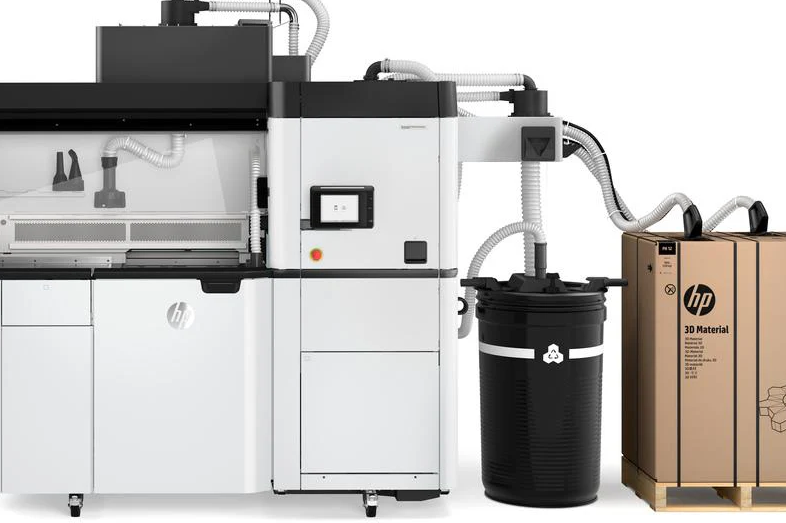
MJF PP parts are produced on HP Multi Jet Fusion systems. The process uses the same MJF method as PA12 but with polypropylene powder. PP has lower density than nylon (0.90 g/cm³), producing the lightest parts in our powder-bed catalog. The powder bed self-supports all geometry. PP has very low moisture absorption (< 0.1%), so drying is less critical than for nylon, but storage in controlled-humidity environments is still standard practice. Parts emerge in a white/gray color. Cooling cycles are managed to control crystallization behavior, which affects dimensional accuracy and mechanical properties.
PP alongside related materials.
| PP | PA12 (MJF) | PA11 (SLS) | TPU 95A | |
|---|---|---|---|---|
| Tensile strength | 30 MPa | 48 MPa | 47 MPa | 27.3 ± 0.8 MPa |
| Heat deflection (HDT) | 100 °C @ 0.45 MPa | 175 °C @ 0.45 MPa | 157 °C @ 0.45 MPa | - |
| Flexural modulus | 1,300–1,500 MPa | 1,730 MPa | ≈ 1,100 MPa | Low–medium (elastomer) |
| Elongation | 20–30% | 15–20% | 40–50% | 250–350% |
| Density | 0.90 g/cm³ | 1.01 g/cm³ | 1.02 g/cm³ | 1.22 g/cm³ |
| Relative cost | $$ | $$ | $$$ | $$ |
Where PP fits, where it doesn't, and what to use instead.
PP's fatigue resistance lets 0.4–0.6 mm hinge webs survive 10,000+ flex cycles - the same property that makes injection-molded PP bottle caps work, now available in printed parts.
Consumer ProductsMoisture absorption under 0.1% keeps dimensions stable in wet and submerged environments where nylon absorbs 0.5–1.5% and swells out of tolerance.
EngineeringResists most acids, bases, alcohols, and aqueous solutions - viable for laboratory fluid routing, agricultural chemical dispensing, and industrial rinse systems.
EnergyLightest powder-bed material at 0.90 g/cm³ (11% lighter than PA12) - matters in drone payloads, wearable enclosures, and battery-weight-constrained designs.
RoboticsLow moisture absorption and broad chemical inertness make PP suitable for single-use and short-term fluid-path prototypes in regulated environments.
Medical DevicesFinishing options and in-stock colors for PP.
De-powdered, matte gray finish.
Best for: Functional & fluid parts
Custom colors and dyeing available on request. Contact us for options.
How MJF works, how it compares to other methods, and when to use it for the best results in functional prototypes and low-volume production.
Read the Article
Many failures come from excessive deflection, creep, or cracking rather than lack of strength. Understanding PA12, PA11, glass-bead PA12, TPU, and FR grades.
Read the Article