
DFM for 3D Printing: A Practical Design Guide
Wall thickness, tolerances, supports, and hole sizing rules for printable parts.
Read the ArticleThe firmest, most print-friendly TPU - flexible parts with structure.
TPU 95A is a high-speed flexible filament that keeps excellent impact resistance and flexibility while being the most print-reliable TPU we offer. It is the go-to for elastic components that still need some rigidity, and it is available for instant quoting.
Thermoplastic Polyurethane (Shore 95A), printed with Fused Deposition Modeling (FDM). Every order is reviewed by our engineering team - no minimum order quantity.
Choose TPU 95A when you need a flexible part with real structural definition - one that bends under deliberate force but holds its shape during handling. At Shore 95A, the material feels like a firm rubber: it absorbs impacts, resists abrasion, and returns to shape, but it does not flop or sag like 85A.
TPU 95A is the only flexible material in our auto-quoter, meaning you get instant pricing and faster turnaround. If your flexible-part need is urgent or the geometry is straightforward, 95A is the fastest path to a printed flexible part.
If you need a softer, more rubber-like feel, step down to 90A (medium flex) or 85A (very soft). Those grades are manually quoted and print slower, but deliver genuine softness that 95A cannot match. For parts that need to flex repeatedly under load - living hinges, snap clips - SLS PA11 offers high elongation (40–50%) in a rigid nylon that may be more appropriate than an elastomer.
Representative values - process- and orientation-dependent. Full technical datasheet available on request.
Plan features to print reliably and assemble cleanly in TPU 95A. Need DFM help?
Dimensional tolerance is ±0.4 mm or ±0.6%. TPU 95A is the most dimensionally accurate flexible material we print - it sags less during printing than 85A or 90A. Functional mating features should still allow 0.4–0.5 mm clearance per side to account for the material's compliance.
TPU 95A prints at 220–240 °C nozzle / 30–60 °C bed at moderate speeds (30–50 mm/s) - significantly faster than softer TPUs. At Shore 95A, the filament is stiff enough to feed reliably even with some Bowden setups, though we use direct-drive for consistency. Retraction can be set to 1.0–2.0 mm without jamming. We dry at 50 °C for 4–6 hours before printing. Supports remove more cleanly from 95A than from softer grades, so moderate overhangs and enclosed features are feasible.
TPU 95A alongside related materials.
| TPU 95A | TPU 90A | TPU 85A | ABS | |
|---|---|---|---|---|
| Tensile strength | 27.3 ± 0.8 MPa | 12.5 ± 0.8 MPa | 12.0 ± 0.8 MPa | 33 ± 3 MPa |
| Heat deflection (HDT) | - | - | - | 87 °C @ 0.45 MPa |
| Flexural modulus | Low–medium (elastomer) | Low (elastomer) | Low (elastomer) | ≈ 2,200 MPa |
| Elongation | 250–350% | 300–400% | 330–450% | 10–15% |
| Density | 1.22 g/cm³ | 1.20 g/cm³ | 1.18 g/cm³ | 1.05 g/cm³ |
| Relative cost | $$ | $$ | $$ | $$ |
Where TPU 95A fits, where it doesn't, and what to use instead.
Auto-quotable and fastest to print among TPUs (30–50 mm/s), so iterating on flexible part geometry takes days instead of the week-plus timeline of softer grades.
Engineering27.3 MPa tensile - nearly double 85A/90A - means grip surfaces resist cuts and gouges that softer TPUs would sustain in industrial handling.
Consumer ProductsAbsorbs and distributes impact energy through elastic deformation; a 2 mm wall survives repeated 1.5 m drops onto concrete without cracking.
Consumer ProductsShore 95A provides enough rigidity to maintain seal profile during installation while still compressing 10–15% for effective flange conformance.
EngineeringFirm enough to hold electronics and circuit boards in position, flexible enough to wrap around wrists and limbs without rigid pressure points.
Medical DevicesFinishing options and in-stock colors for TPU 95A.
As-printed; matte flexible surface.
Best for: Functional flexible parts
Custom colors and dyeing available on request. Contact us for options.
Wall thickness, tolerances, supports, and hole sizing rules for printable parts.
Read the Article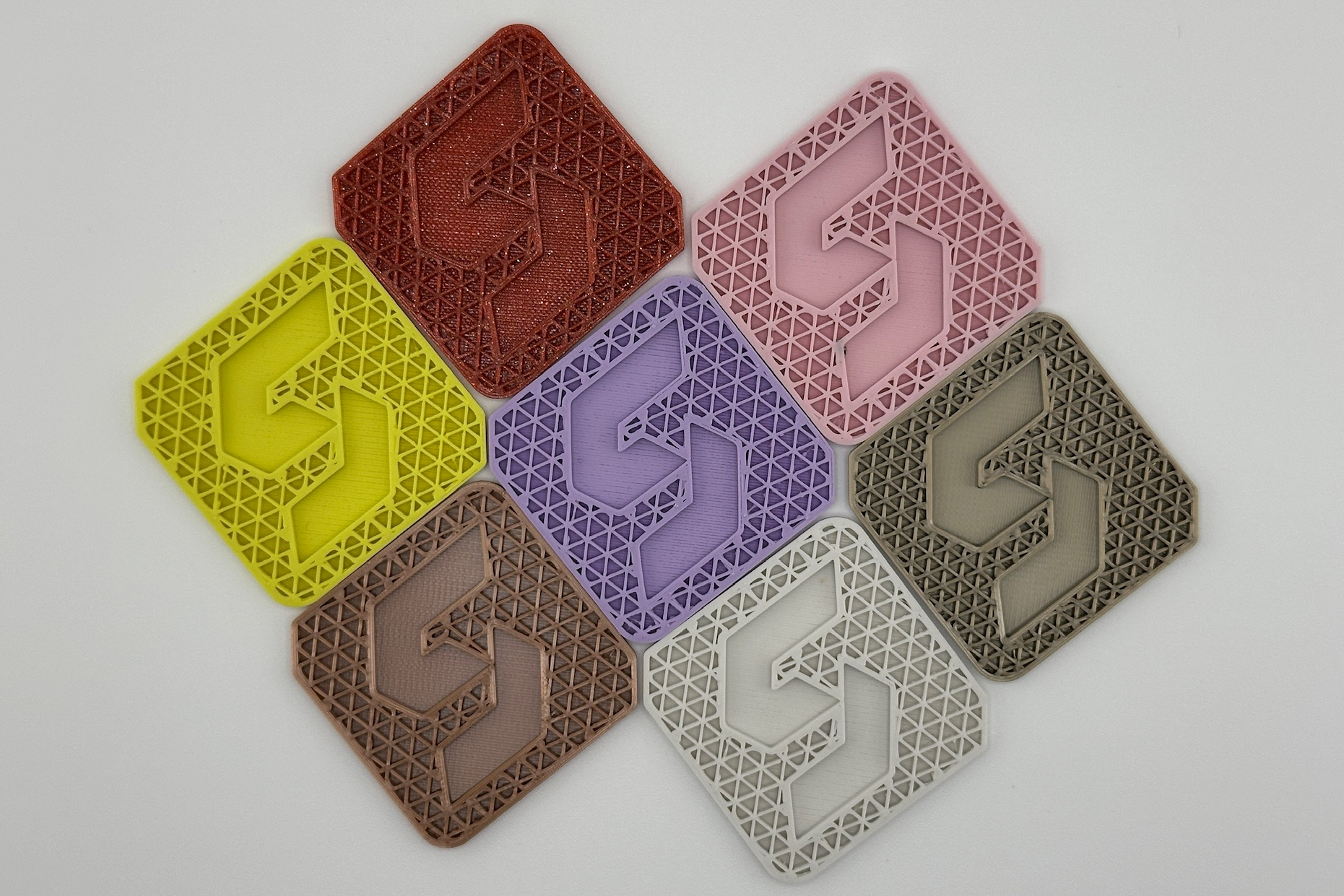
Infill affects the strength, weight, and efficiency of 3D printed parts. Learn how patterns and density influence performance and cost.
Read the Article