Multi Jet Fusion (MJF) 3D Printing: Complete Guide
How MJF works, how it compares to other methods, and when to use it for the best results in functional prototypes and low-volume production.
Read the ArticleFine-feature nylon for detailed, repeatable short-run production.
MJF PA12 produces strong, chemically resistant nylon parts with fine features and excellent dimensional accuracy and repeatability. Multi Jet Fusion builds fast across full trays, making PA12 a cost-effective choice for detailed parts and short-run production from tens to thousands of units.
Nylon Polyamide 12 - Multi Jet Fusion, printed with Multi Jet Fusion (MJF). Every order is reviewed by our engineering team - no minimum order quantity.
Choose MJF PA12 when you need nylon parts at production-scale consistency - fine features, tight part-to-part repeatability, and cost that improves with quantity. MJF is the process to use when you are producing 50–5,000 identical nylon parts and need each one to match the last. The full-tray build process means per-part cost drops as you fill trays, making MJF the most cost-effective powder-bed option for short-run production.
MJF PA12 and SLS PA12 have nearly identical mechanical properties - same tensile, same elongation, same chemical resistance. The differences are process-driven: MJF resolves finer features (0.5 mm vs 0.75 mm), offers slightly tighter repeatability, and builds faster at scale. SLS offers a larger build volume (up to 550 mm tall vs 380 mm) for oversized parts.
If your part needs more toughness and flexibility than PA12 provides, SLS PA11 is the ductile nylon option - MJF PA11 is not widely available. If you need chemical resistance with excellent fatigue life, MJF PP (polypropylene) is the alternative for living hinges and fluid-handling parts.
Representative values - process- and orientation-dependent. Full technical datasheet available on request.
Plan features to print reliably and assemble cleanly in PA12 (MJF). Need DFM help?
Typical tolerance is ±0.3 mm or ±0.2% (whichever is greater) - slightly tighter than SLS for fine features. MJF's inkjet-based process achieves very consistent part-to-part repeatability, making it well suited to production runs where dimensional consistency matters. Post-machining is available for critical bores and mating surfaces.
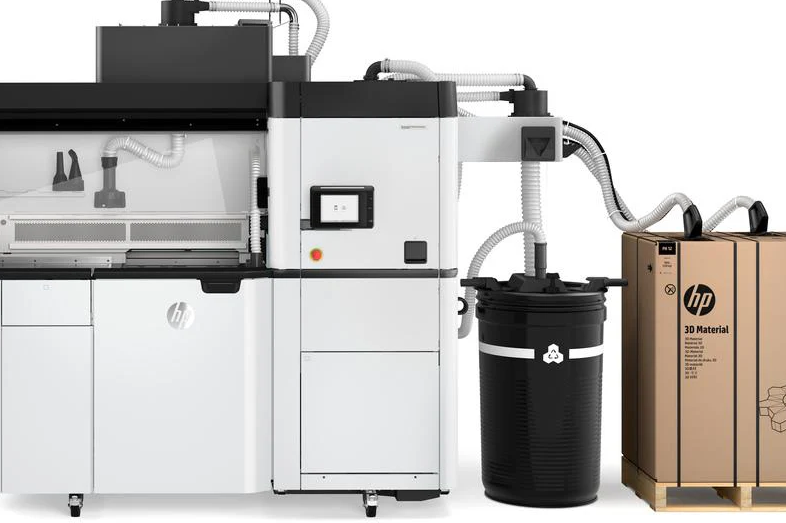
MJF PA12 parts are produced on HP Multi Jet Fusion systems. The process uses HP inkjet technology to deposit fusing and detailing agents onto nylon powder, then fuses each layer with infrared energy. The process builds entire trays simultaneously, so per-part cost drops significantly when nesting multiple parts or producing batches. Parts emerge in a gray color due to the fusing agent; black dyeing is available for uniform cosmetic appearance. Cooling is controlled over 12–24 hours depending on tray density. The powder bed self-supports all geometry - no support structures. Orientation matters less than FDM but still affects surface finish: upward-facing surfaces are smoothest.
PA12 (MJF) alongside related materials.
| PA12 (MJF) | PA12 (SLS) | PP | PA11 (SLS) | |
|---|---|---|---|---|
| Tensile strength | 48 MPa | 48 MPa | 30 MPa | 47 MPa |
| Heat deflection (HDT) | 175 °C @ 0.45 MPa | 154 °C @ 0.45 MPa | 100 °C @ 0.45 MPa | 157 °C @ 0.45 MPa |
| Flexural modulus | 1,730 MPa | 1,730 MPa | 1,300–1,500 MPa | ≈ 1,100 MPa |
| Elongation | 15–20% | 15–20% | 20–30% | 40–50% |
| Density | 1.01 g/cm³ | 1.01 g/cm³ | 0.90 g/cm³ | 1.02 g/cm³ |
| Relative cost | $$ | $$$ | $$ | $$$ |
Where PA12 (MJF) fits, where it doesn't, and what to use instead.
Resolves features down to 0.5 mm - finer than SLS (0.75 mm) - for parts with small text, thin ribs, and intricate snap-tab geometry.
Consumer ProductsFull-tray builds produce 50–200+ parts per run with <2% part-to-part variation, making MJF the most repeatable powder-bed process for production.
Consumer ProductsPowder-bed self-support prints internal baffles, channels, and undercuts impossible in FDM - same design freedom as SLS with faster throughput.
Engineering15–20% elongation handles snap-arm deflection through hundreds of assembly cycles, and MJF's dimensional consistency keeps interference fits repeatable across production batches.
Consumer ProductsPer-part cost drops 40–60% at 100+ units compared to FDM, with no tooling investment - fills the gap between prototyping and injection molding.
EngineeringFinishing options and in-stock colors for PA12 (MJF).
De-powdered, matte gray finish.
Best for: Functional parts
Uniform black; no dimensional change.
Best for: Cosmetic uniformity
Smoother satin surface.
Best for: Handled parts
Custom colors and dyeing available on request. Contact us for options.
How MJF works, how it compares to other methods, and when to use it for the best results in functional prototypes and low-volume production.
Read the Article
Many failures come from excessive deflection, creep, or cracking rather than lack of strength. Understanding PA12, PA11, glass-bead PA12, TPU, and FR grades.
Read the Article