Rapid Prototyping Guide: Methods, Materials, and Process Selection
A breakdown of FDM, SLA, SLS, MJF, and CNC machining for prototype development: when to use each, how to match process and material to your validation goal.
Read the ArticleHDPE-like resin with 180% elongation and exceptional fatigue resistance.
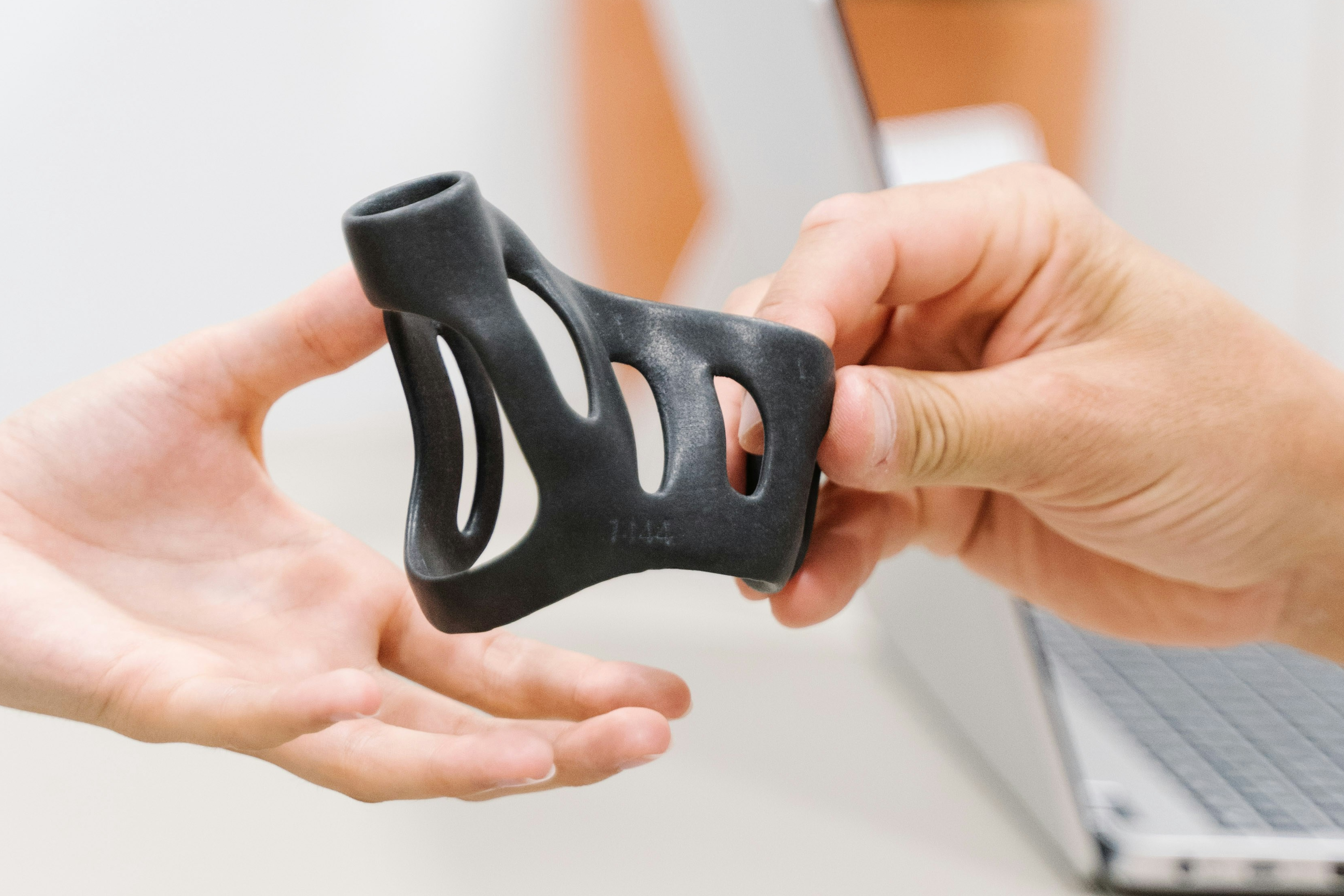
Tough 1000 is the most flexible resin in the Formlabs engineering lineup, delivering 180% elongation and 26.3 MPa tensile with a feel similar to HDPE. It excels at parts that must bend repeatedly, absorb impact, or deform without fracturing - squeeze-to-open mechanisms, flexible snap-tabs, and fatigue-loaded fixtures.
Formlabs Tough 1000 Resin, printed with Stereolithography (SLA). Every order is reviewed by our engineering team - no minimum order quantity.
Choose Tough 1000 when your SLA part must bend, flex, or deform repeatedly without fracturing. At 180% elongation, it simulates HDPE behavior - the kind of deformation you see in squeeze bottles, flexible packaging caps, and cable clips. No other SLA resin in the catalog comes close to this level of flexibility.
Tough 1000 is not strong or stiff - 26.3 MPa tensile and 932 MPa flex modulus put it well below Grey V5 and the other Tough resins. The trade-off is intentional: you choose Tough 1000 specifically because you need a part that gives rather than cracks. If you need more stiffness with still-good elongation, move up to Tough 1500 (PP-like, 33 MPa, 30–40%) or Tough 2000 (ABS-like, 42 MPa, 79%).
For true elastomeric behavior - rubber-like compression and rebound - FDM TPU is a different category entirely. Tough 1000 is a flexible plastic, not an elastomer. Its advantage over TPU is SLA precision: ±0.1 mm tolerances and fine features that FDM TPU cannot achieve.
Representative values - process- and orientation-dependent. Full technical datasheet available on request.
Plan features to print reliably and assemble cleanly in Tough 1000. Need DFM help?
Typical tolerance on the Form 4 is ±0.1 mm or ±0.15%. Flexible materials may spring back after printing, so very thin features can shift slightly from nominal geometry. Parts thicker than 3 mm hold tolerance well. Post-machining is not recommended on Tough 1000 - the material deforms under tooling pressure.
Tough 1000 prints on the Form 4 at 50–100 µm layer height. After printing, wash in IPA for 15–20 minutes - slightly longer than rigid resins because the flexible surface retains resin in concavities. Post-cure at 60 °C for 60 minutes under 405 nm UV light. Under-curing leaves parts too soft; over-curing makes them stiffer and more brittle than spec. Support removal requires care - the flexible material can tear at thin support contact points. Orient parts to minimize supports on thin-wall regions.
Tough 1000 alongside related materials.
| Tough 1000 | Tough 1500 | Tough 2000 | Durable | |
|---|---|---|---|---|
| Tensile strength | 26.3 MPa | 33 MPa | 42 MPa | 28 MPa |
| Heat deflection (HDT) | 55 °C @ 0.45 MPa | 52 °C @ 0.45 MPa | 54 °C @ 0.45 MPa | 41 °C @ 0.45 MPa |
| Flexural modulus | 932 MPa | 1,400 MPa | 1,500 MPa | - |
| Elongation | 180% | 30–40% | 79% | 55% |
| Density | 1.15 g/cm³ | 1.15 g/cm³ | 1.15 g/cm³ | 1.13 g/cm³ |
| Relative cost | $$$ | $$$ | $$$ | $$$ |
Where Tough 1000 fits, where it doesn't, and what to use instead.
180% elongation lets printed prototypes replicate the squeeze-to-open and living-hinge behavior of HDPE bottles and caps for consumer testing.
Consumer ProductsExceptional fatigue resistance survives thousands of flex cycles on cable clips, retaining tabs, and snap-on covers that must open and close daily.
EngineeringHDPE-like compliance at 932 MPa flex modulus lets designers validate catheter hubs, flexible connectors, and luer fittings in a printed prototype rather than waiting for molded samples.
Medical DevicesHigh elongation absorbs and distributes impact energy across the part surface rather than fracturing - suitable for protective guards on robotics and automation equipment.
RoboticsPrinted fixtures that must flex around irregular workpieces during inspection or assembly without cracking on the 50th cycle.
EngineeringFinishing options and in-stock colors for Tough 1000.
Washed, post-cured; translucent green surface.
Best for: Functional flexible prototypes
Custom colors and dyeing available on request. Contact us for options.
A breakdown of FDM, SLA, SLS, MJF, and CNC machining for prototype development: when to use each, how to match process and material to your validation goal.
Read the Article