Rapid Prototyping Guide: Methods, Materials, and Process Selection
A breakdown of FDM, SLA, SLS, MJF, and CNC machining for prototype development: when to use each, how to match process and material to your validation goal.
Read the ArticleABS-like resin with high elongation and stiffness for functional prototypes.
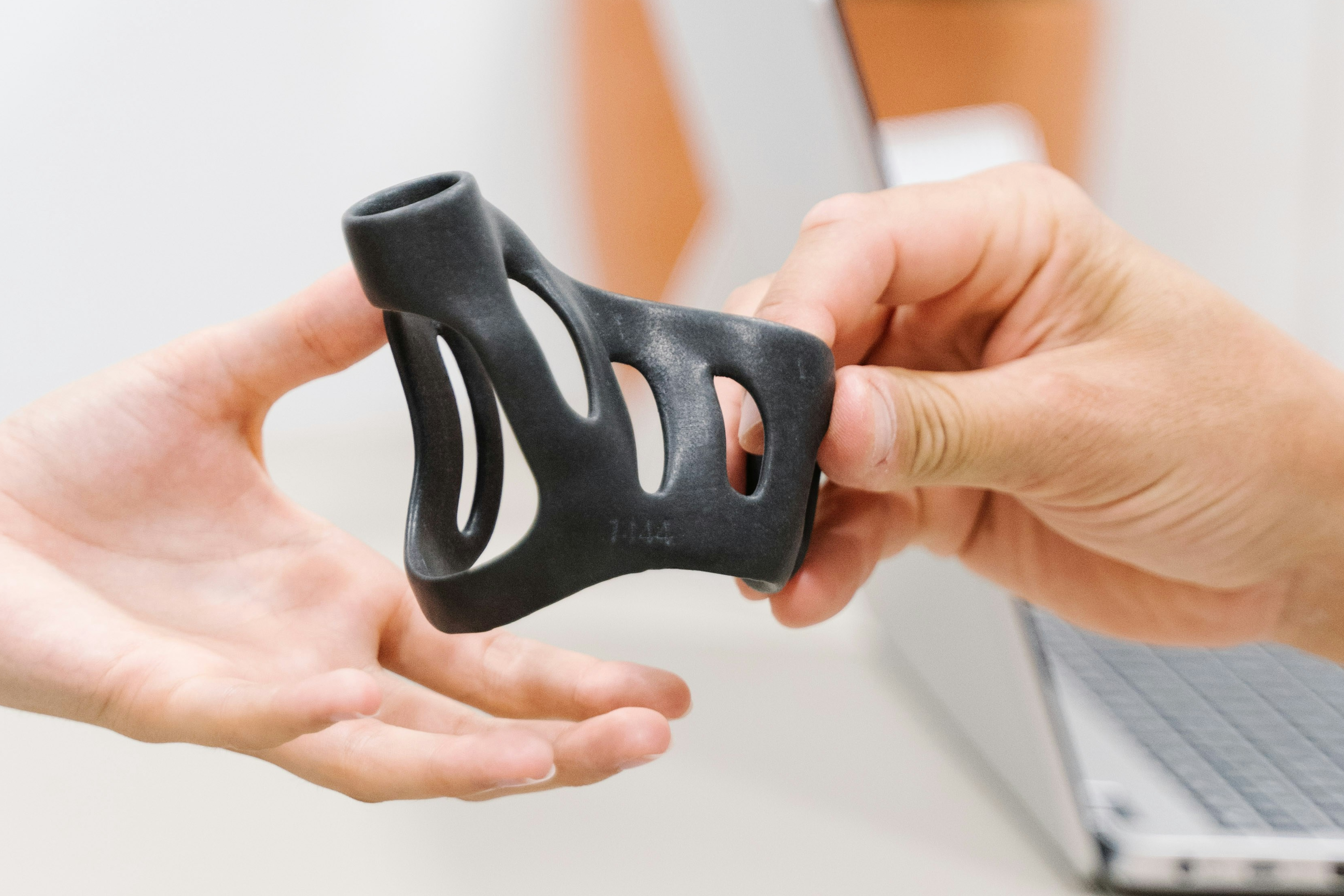
Tough 2000 is the stiffest and strongest resin in the Formlabs Tough series, delivering ABS-like properties - 42 MPa tensile, 1,500 MPa flex modulus, and 79% elongation. It bridges the gap between rigid SLA resins and flexible ones, making it the default for functional prototypes that must survive real-world handling.
Formlabs Tough 2000 Resin V2, printed with Stereolithography (SLA). Every order is reviewed by our engineering team - no minimum order quantity.
Choose Tough 2000 when your SLA prototype must survive real-world handling - drops, vibration, assembly and disassembly, and user testing. It is the toughest resin in the Formlabs lineup, combining 42 MPa tensile with 79% elongation for ABS-like performance at SLA precision.
If your part is a visual-only prototype or a fit check that will not be abused, Grey V5 is stronger (62 MPa) and stiffer (2,750 MPa) at a lower cost. Tough 2000 costs more and is softer - the trade-off is toughness. Choose it only when the part will actually see mechanical stress.
For parts that need more flexibility - living hinges, squeeze-fit mechanisms - step down to Tough 1500 (PP-like) or Tough 1000 (HDPE-like). For production-grade ABS-like parts, FDM ABS is tougher under impact and has much better heat resistance (87 °C vs 54 °C). Tough 2000 excels specifically where SLA precision matters and the part must also survive handling.

Representative values - process- and orientation-dependent. Full technical datasheet available on request.
Plan features to print reliably and assemble cleanly in Tough 2000. Need DFM help?
Typical tolerance on the Form 4 is ±0.1 mm or ±0.15%. Tough 2000 holds geometry well on parts up to 150 mm. Thin walls under 0.5 mm may flex during wash and cure steps. For functional assemblies, design interference fits 0.1 mm tighter than rigid SLA to account for the material's compliance.
Tough 2000 prints on the Form 4 at 50–100 µm layer height. Wash in IPA for 15–20 minutes after printing. Post-cure at 60 °C for 60 minutes under 405 nm UV light. Cure time is critical - under-cured parts are too flexible and do not reach spec stiffness; over-cured parts become stiffer but lose the elongation that makes Tough 2000 valuable. Supports orient away from impact faces and functional surfaces where witness marks could create stress concentrators.
Tough 2000 alongside related materials.
| Tough 2000 | Tough 1500 | Grey V5 | ABS | |
|---|---|---|---|---|
| Tensile strength | 42 MPa | 33 MPa | 62 MPa | 33 ± 3 MPa |
| Heat deflection (HDT) | 54 °C @ 0.45 MPa | 52 °C @ 0.45 MPa | 71 °C @ 0.45 MPa | 87 °C @ 0.45 MPa |
| Flexural modulus | 1,500 MPa | 1,400 MPa | 2,750 MPa | ≈ 2,200 MPa |
| Elongation | 79% | 30–40% | 13% | 10–15% |
| Density | 1.15 g/cm³ | 1.15 g/cm³ | 1.18 g/cm³ | 1.05 g/cm³ |
| Relative cost | $$$ | $$$ | $$ | $$ |
Where Tough 2000 fits, where it doesn't, and what to use instead.
42 MPa tensile and 79% elongation let printed housings survive repeated drop tests, assembly cycles, and user handling that crack rigid SLA resins like Grey V5.
EngineeringSLA precision (±0.1 mm) combined with ABS-like toughness means interference fits, press-fit pins, and threaded inserts hold up through prototype evaluation.
EngineeringPrinted prototypes feel and behave like injection-molded ABS during focus groups and user testing - stiff enough to be structural, tough enough to survive daily handling.
Consumer Products1,500 MPa flex modulus and 79% elongation replicate the touch-and-feel of ABS instrument panel components, allowing design reviews on printed samples rather than soft-tooled parts.
AutomotiveTough 2000 absorbs vibration and impact at motor mounts and sensor brackets without cracking - where rigid SLA parts fracture after a single drop.
RoboticsFinishing options and in-stock colors for Tough 2000.
Washed, post-cured; translucent green surface.
Best for: Functional prototypes
Support marks removed, painted to specification.
Best for: User-testing samples
Custom colors and dyeing available on request. Contact us for options.
A breakdown of FDM, SLA, SLS, MJF, and CNC machining for prototype development: when to use each, how to match process and material to your validation goal.
Read the Article
Wall thickness, tolerances, supports, and hole sizing rules for printable parts.
Read the Article