
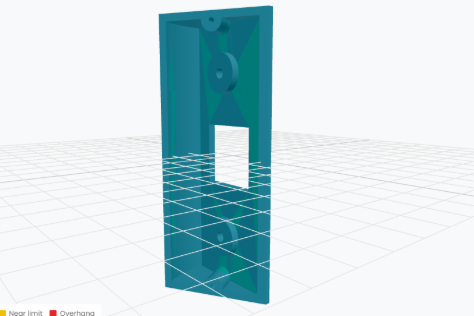
DFM for 3D Printing: A Practical Design Guide
Wall thickness, tolerances, supports, and hole sizing rules for printable parts.
Read the ArticleStatic-dissipative resin for electronics handling, fixtures, and ESD-sensitive assemblies.
ESD resin is a static-dissipative SLA material engineered for electronics manufacturing fixtures, chip trays, and any application where uncontrolled static discharge can damage sensitive components. At 42 MPa tensile, 1,900 MPa flex modulus, and controlled surface resistivity, it prevents charge buildup while maintaining genuine structural capability.
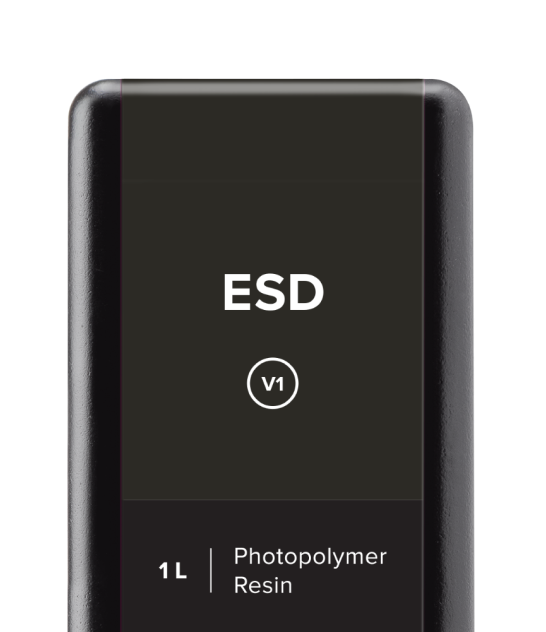
Formlabs ESD Resin, printed with Stereolithography (SLA). Every order is reviewed by our engineering team - no minimum order quantity.
Choose ESD resin when your fixture, tray, or enclosure will contact ESD-sensitive electronics. Its controlled surface resistivity (10⁶–10⁹ Ω) prevents the static discharge events that damage ICs, MEMS, RF components, and sensitive analog circuits. It is the only ESD-safe 3D-printed material in our catalog that delivers SLA-grade precision.
At 42 MPa tensile and 1,900 MPa flex modulus, ESD resin is structurally capable - it supports pogo-pin test loads, component insertion forces, and fixture clamping without flexing. The ±0.1 mm tolerance reproduces chip-pocket dimensions and alignment features that match production tooling.
If your part does not contact ESD-sensitive electronics, do not specify ESD resin - Grey V5 is stronger (62 MPa), stiffer (2,750 MPa), and costs half as much. For ESD fixtures that must handle higher temperatures (above 66 °C), consider machined ESD-safe plastics or discuss alternatives with us. For larger ESD parts beyond the 200 mm build envelope, FDM options with ESD-safe coatings may be appropriate.
Representative values - process- and orientation-dependent. Full technical datasheet available on request.
Plan features to print reliably and assemble cleanly in ESD. Need DFM help?
Typical tolerance on the Form 4 is ±0.1 mm or ±0.1%. The filled formulation holds dimensions well during cure. For chip-tray pockets and alignment features, the SLA precision is adequate to match production tray dimensions. Verify critical pocket dimensions against component datasheets at DFM review.
ESD resin prints on the Form 4 at 50–100 µm layer height. Wash in IPA for 10–15 minutes after printing. Post-cure at 60 °C for 30–60 minutes under 405 nm UV light to reach full mechanical and ESD performance. The carbon-based filler that provides static dissipation also gives the material its matte black color. Support removal should use flush cutters - the material is brittle. Handle finished parts with ESD-safe gloves to avoid contaminating the dissipative surface.
ESD alongside related materials.
| ESD | Flame Retardant | Rigid 10K | Grey V5 | |
|---|---|---|---|---|
| Tensile strength | 42 MPa | 56 MPa | 88 MPa | 62 MPa |
| Heat deflection (HDT) | 66 °C @ 0.45 MPa | 111 °C @ 0.45 MPa | 238 °C @ 0.45 MPa | 71 °C @ 0.45 MPa |
| Flexural modulus | 1,900 MPa | 2,900 MPa | - | 2,750 MPa |
| Elongation | 5.5% | 5% | 1.7% | 13% |
| Density | 1.25 g/cm³ | 1.30 g/cm³ | 1.45 g/cm³ | 1.18 g/cm³ |
| Relative cost | $$$$ | $$$$ | $$$$ | $$ |
Where ESD fits, where it doesn't, and what to use instead.
Controlled surface resistivity (10⁶–10⁹ Ω) dissipates static charge gradually, preventing ESD damage to ICs during SMT assembly while holding ±0.1 mm positional accuracy.
EngineeringSLA precision reproduces pocket dimensions and retention features that match production chip trays, enabling process validation with ESD-safe printed carriers.
Engineering42 MPa tensile at 1,900 MPa flex modulus supports pogo-pin test loads and component insertion forces without flex, while ESD-safe surface protects populated boards.
EngineeringNon-shedding, static-dissipative surface prevents particle attraction in cleanroom environments - critical for semiconductor and medical-device inspection jigs.
Medical DevicesPrinted ESD-safe housings let designers validate form factor, connector placement, and thermal management on boards with sensitive RF and analog circuits.
Consumer ProductsFinishing options and in-stock colors for ESD.
Washed, post-cured; matte black ESD-safe surface.
Best for: Electronics fixtures, chip trays
Custom colors and dyeing available on request. Contact us for options.
Wall thickness, tolerances, supports, and hole sizing rules for printable parts.
Read the Article