How to Choose the Right MJF Materials for Functional Prototypes and Production Parts
Introduction
Choosing the right MJF materials is one of the most important decisions in any Multi-Jet Fusion project. In many real-world applications, parts do not fail because they are not strong enough. They fail because they bend too much, creep under load, crack at sharp corners, or change shape over time.
When reviewing an MJF 3D printing service, we find clients are often most focused on part geometry, cost, and lead time. While these do matter, long-term performance depends on selecting the correct MJF materials for the actual load, environment, and use case.
MJF materials are not simply different versions of generic nylon. Their performance depends on the polymer type, filler content, print conditions, build orientation, and post-processing. Datasheets provide useful reference values, but they do not replace real testing.
For teams moving from prototype to production with an MJF 3D printing service, material selection must connect directly to how the part will function in service. This guide explains how to choose among common MJF materials, including PA12, PA11, glass–bead–filled PA12, TPU, and flame-retardant nylon 12 (PA12-FR).
In This Guide You Will Learn:
• How MJF materials behave in real applications
• The key differences between PA12, PA11, PA12 GB, TPU, and flame-retardant grades
• How stiffness, creep, fatigue, and environment affect material choice
• How to match MJF materials to specific part types
• How to validate parts produced by an MJF 3D printing service before scaling production
Not sure if MJF is the right process for your project? Read our guide on MJF
The Technical Core: How to Select the Right MJF Material
Understanding MJF Material Behavior
While generally considered isotropic, MJF materials can show small variations based on build orientation and part geometry. Test values such as tensile strength and modulus are usually measured using ASTM D638 test bars under controlled conditions. Real parts may behave differently.
Moisture also affects polyamide-based MJF materials. Over time, absorbed moisture can slightly change stiffness and dimensions. This matters in tight-tolerance assemblies.
For this reason, we recommend that MJF materials should be selected based on the part’s primary failure mode.
PA12: The Structural Baseline
Among standard MJF materials, PA12 is the most widely used. It offers a balanced mix of stiffness, strength, and dimensional stability.
Typical PA12 datasheets for MJF materials show tensile strength in the upper 40 MPa range and a tensile modulus of 1.6 to 1.8 GPa. Exact values depend on print parameters.
PA12 works well when:
• The part must hold its shape under moderate load
• Dimensional stability is important
• Snap features are properly designed with smooth radii
• The part is primarily structural
PA12 may not be ideal for parts that flex repeatedly or for those that carry larger sustained loads for long periods. In those cases, other MJF materials may perform better.
PA11: Better for Flexing and Impact
PA11 is chosen when ductility and fatigue resistance are more important than stiffness.
Compared to PA12, PA11 generally offers higher elongation at break. This makes it better suited for snap-fits, clips, and parts that flex repeatedly. It can also perform better in impact-prone applications.
PA11 is often a good choice if:
• Snap arms must cycle multiple times
• Impact resistance is critical
• Cracking at stress concentrators is a concern
However, keep in mind that PA11 does not significantly increase stiffness. If the part is deflecting too much, changing from PA12 to PA11 will not solve that problem.
PA12 Glass Bead Filled: Higher Stiffness
Glass–bead–filled PA12 is one of the stiffest MJF materials available from many MJF 3D printing service providers.
Adding glass beads increases tensile modulus and reduces deflection. This helps in fixtures, brackets, and alignment-sensitive parts.
The tradeoff is lower elongation and reduced impact resistance. These MJF materials are less tolerant of bending and are not recommended for flexible snap features.
Glass-filled PA12 is a strong option when:
• Deflection is the main issue
• Large flat parts must remain stable
• Assembly alignment depends on rigidity
Designers should reduce sharp corners and bending stresses when using filled MJF materials.
TPU: For Elastic and Interface Applications
TPU (Thermoplastic Polyurethane) is different from nylon-based MJF materials. It is flexible and elastic rather than rigid.
TPU offered by an MJF 3D printing service is commonly used for seals, gaskets, vibration dampers, and grip features. It typically has Shore A hardness in the high 80s to low 90s and high elongation at break.
TPU should be selected when controlled compression or flexibility is required. Validation should focus on compression set, wear behavior, and surface interaction with mating parts.
At Simple Machining, our MJF 3D printing service offers TPU in 88A.
Flame-Retardant Nylon: When Compliance Is Required
Flame-retardant grades are specialized MJF materials used when standards such as UL94 V0 must be met.
An experienced MJF 3D printing service will confirm that flame ratings depend on wall thickness. According to HP, UL94-V0 is achieved for a wall thickness greater than 2.5mm
When choosing flame-retardant MJF materials, engineers should confirm rating requirements, verify wall thickness, and test complete assemblies early in the design process.
Material Selection by Part Category
The following can be used as a rule of thumb to decide early on in the process:
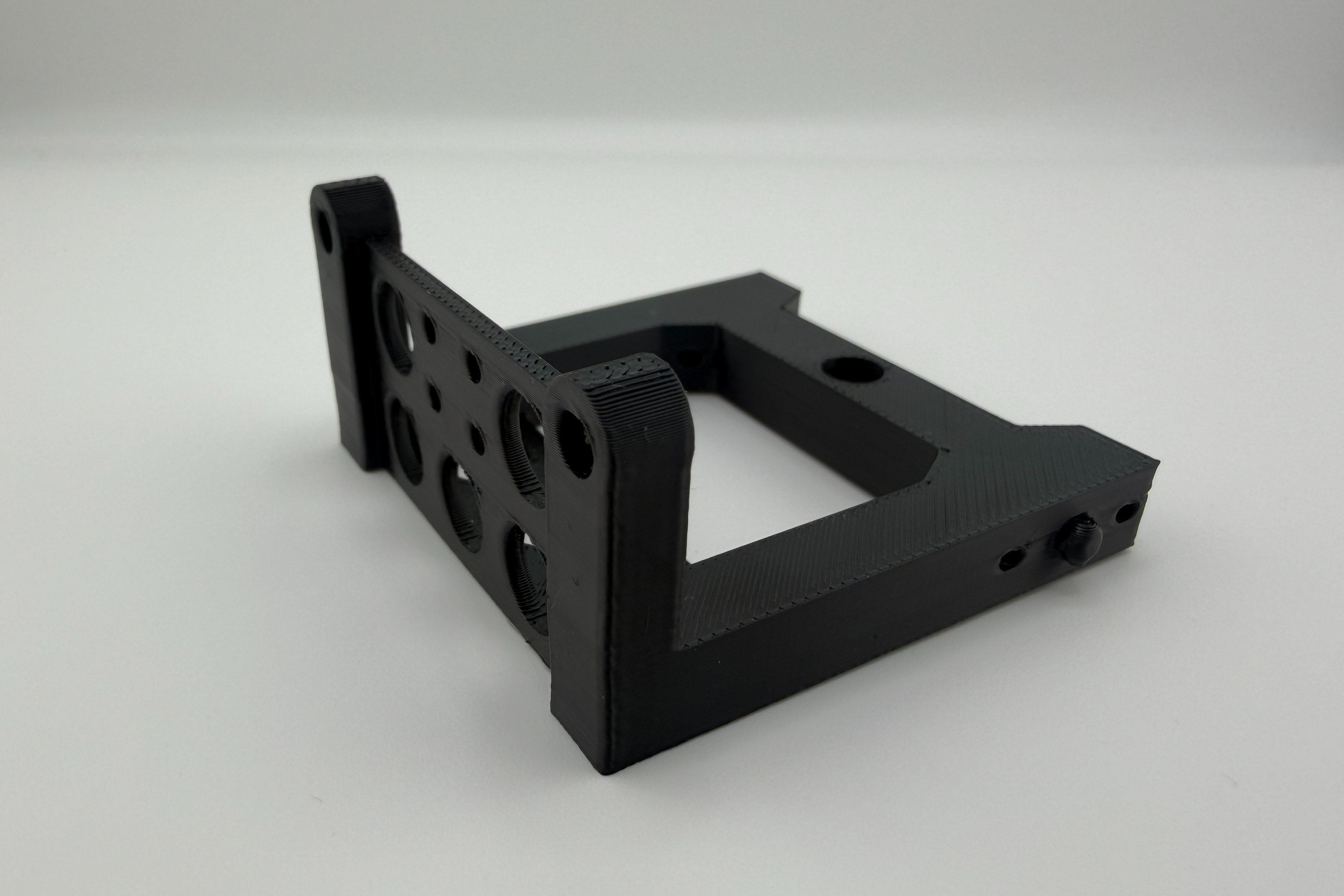
- For housings and brackets made through an MJF 3D printing service, PA12 is usually the starting point among MJF materials.
- For snap-fits and repeated flexing parts, PA11 is often preferred.
- For high-stiffness fixtures or alignment-critical parts, glass bead–filled PA12 may provide better results.
- For seals, vibration isolators, and grip elements, TPU-based MJF materials are the correct choice.
Validation Strategy for Production-Intent MJF Parts
After selecting MJF materials, it is essential to validate material performance.
- Start by identifying the primary failure mode.
- Confirm the operating environment.
- Print critical features in worst-case orientation through your MJF 3D printing service.
- Test fit and function after finishing. Measure deflection, retention force, or compression under realistic loads.
This process ensures that MJF materials selection is based on real performance data. Early testing reduces redesign cycles and helps avoid production delays.
Do you need help with optimizing your model for MJF? We offer DFM services!
Conclusion
While geometry and cost are important, selecting the right MJF materials is also a critical part of the design process.
- PA12 is the ‘general-purpose’ MJF material.
- PA11 improves performance in flexing and fatigue-driven parts.
- Glass bead–filled PA12 increases stiffness.
- TPU enables elastic performance. Flame-retardant MJF materials address regulatory requirements.
Material decisions should be driven by failure mode and validation data. When MJF materials are selected carefully and tested properly, they can support both functional prototyping and production applications with consistent results.
FAQ
What are the most common MJF materials?
The most common MJF materials are PA12, PA11, glass bead–filled PA12, TPU, and flame-retardant PA12. The correct choice depends on stiffness, flexibility, impact needs, and compliance requirements within the intended MJF 3D printing service application.
How do I choose the right MJF 3D printing service?
Look for an MJF 3D printing service that offers a full range of MJF materials, strong process control, inspection capability, and experience with production parts. Material availability and finishing options directly affect performance.
Is PA12 suitable for production parts?
Yes. PA12 is one of the most widely used MJF materials for low-volume production. Validation should confirm creep resistance and dimensional stability under expected loads.
Are MJF materials isotropic?
MJF materials are generally more isotropic than some other additive processes, but minor differences can still exist depending on build orientation and print conditions.
Do finishing processes affect MJF materials' performance?
Yes. Bead blasting, dyeing, smoothing, and coatings can change surface friction, fit, and wear behavior.
To get started with an MJF quote, you can submit a quote request here
Disclaimer
The content appearing on this webpage is for informational purposes only. Simple Machining makes no representation or warranty of any kind, be it expressed or implied, as to the accuracy, completeness, or validity of the information. Any performance parameters, geometric tolerances, specific design features, quality and types of materials, or processes should not be inferred to represent what will be delivered by Simple Machining. Buyers seeking quotes for parts are responsible for defining the specific requirements for those parts. Please refer to our terms and conditions for more information.